


Brand Deep Dive: Swiftwick, The Tennessee Sock Company That Refuses to Cut Corners
Nobody gets into the outdoors because of socks. But ask anyone who's finished a long day on the trail with hot spots on both heels, and they'll tell you socks are the difference between a good day and a miserable one.
Swiftwick has built an entire company on that idea — and they've done it about two hours up the road from us, in Nashville Tennessee, in a domestic textile industry that mostly stopped existing decades ago.
Here's why we think they're worth knowing beyond the product on the shelf.

It Started With Blisters
The origin story is refreshingly unglamorous. In 2008, an avid mountain biker got fed up with blisters and decided to do something about it. That's it. No venture-backed disruption narrative, no founder mythology — just someone who rode enough to know the existing options weren't good enough.
Nearly two decades later, that company is in Nashville, still making socks, and now on the feet of Tour de France cyclists, track athletes at the 2024 US Olympic Team Trials, and winners of the Western States 100 and MIUT 115 ultramarathons.
But it's still a small operation. Fewer than 40 employees. That's not a knock — it's the point. This is a company small enough that the people designing the socks are the people testing them.


They Actually Make Swiftwick Socks Here, in the USA
This is the part most people don't realize, and it's the single most important thing about Swiftwick.
Swiftwick socks are made in the USA. Not "designed in the USA, assembled elsewhere." Actually knit domestically, with domestically sourced materials wherever possible, by craftspeople in local communities.
That matters for three reasons, and none of them are just flag-waving:
Quality control. When the factory is down the road, you catch problems in days instead of months.
Environmental impact. Fewer garment miles, and more control over which materials and processes go into the product.
Local jobs. American textile manufacturing is a shadow of what it was. Swiftwick chose the harder, more expensive path and stuck with it.
For a $20 sock, keeping production domestic is a genuinely costly decision. Most brands in this category made the other choice a long time ago.

The Lifetime Performance Guarantee Is Not Marketing Fluff
Plenty of brands offer warranties with fine print about "manufacturing defects." Swiftwick's is one sentence:
If your Swiftwicks wear out for any reason, they'll replace them.
Any reason. Not defects — wear. You ran 800 miles in them and blew out the heel? Replaced.
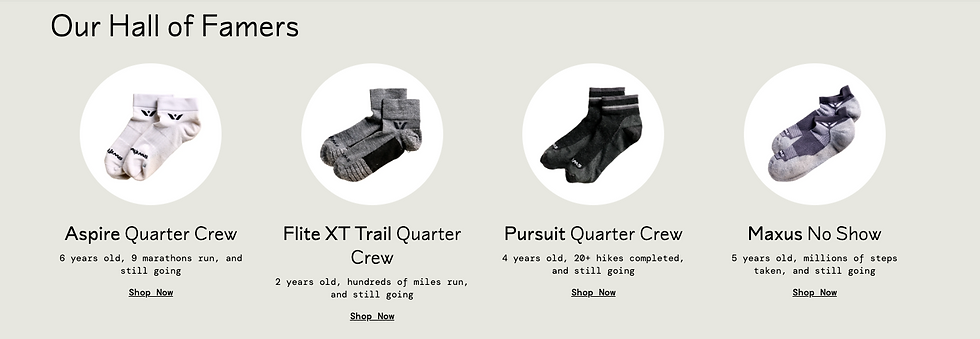
What we love is that they built a "Hall of Famers" page to show off the socks that didn't need replacing: a pair of Aspire quarter crews six years old with nine marathons on them. Pursuit quarter crews four years old after 20+ hikes. A pair of Maxus no-shows at five years and counting.
That's a strange thing for a sock company to brag about, because it's actively arguing against you buying more socks. It also happens to be the most convincing possible argument for buying theirs.

The Design Philosophy: No Voids
Swiftwick's core design principle is simple and slightly obsessive: a sock should have no empty space in it.
Every sock is built to the contours of the foot, because voids are where the trouble starts. Empty space means the fabric shifts, and shifting fabric means friction, and friction means blisters. That's why their socks run compression-fit rather than loose — it's not about a "compression" trend, it's about eliminating the gaps.
The second principle is fiber selection, and this is where they get nerdy:
Olefin — extremely light, excellent at moving moisture, and naturally resistant to stains, mildew, perspiration, and abrasion. Swiftwick is one of the very few brands using it at real scale, in the Aspire, Vision, and Flite XT lines.
RWS Merino wool — used in the Pursuit and Flite XT Trail lines. Thin enough to wear against skin without itch, naturally odor-resistant, and warm even when damp. The Responsible Wool Standard certification tracks animal welfare and land management from farm to finished sock.
Nylon — dialed in carefully per sock, because too much makes a sock durable but harsh, and too little makes it soft but disposable.


The Product Lines, Decoded
If you've ever stood in front of a Swiftwick display feeling mildly overwhelmed, here's the map:
Aspire — ultralight with firm compression. Hot weather, road running, cycling. The one to grab for a Southeast summer.
Maxus — maximum cushion. The plush option for long days and high-mileage running.
Pursuit — all-season merino. The most versatile line; great for hiking and for people who run cold.
Flite XT — their stability line, with an ankle-wrapping design for lateral movement and repetitive motion.
Flite XT Trail — same stability construction with merino added. Made for technical trail.
Vision — style-forward with the same performance underneath.
Hockey — cut-resistant protection for skaters.
Valor — the adaptive line (more on this below).

Valor: The Line That Tells You Who They Are
If you want one thing that captures Swiftwick's character, it's Valor.
Valor is a line of prosthetic liner socks for amputees — above-knee and below-knee — worn against the skin under a liner to wick moisture, prevent blisters, and gently support the residual limb. It uses Flexival, an elastic material produced without solvents, which eliminates a common source of skin irritation and allergic reaction, and runs about 40% less bulky than conventional alternatives.
There is no version of the math where a prosthetic liner sock is the profitable use of a small company's engineering time. They built it anyway, and then partnered with Southern Prosthetics Supply to get it into thousands of clinics worldwide so people could actually find it.
Their tagline for the line is "Nothing Holds You Back." For once, that's not just copy.
Sustainability Without the Sermon
Swiftwick's approach here is refreshingly concrete. Every sock includes what they call R3 fibers — Recycled, Responsible, or Renewable:
Recycled: fibers from post-consumer or post-industrial waste (the Maxus Zero uses fibers made from recycled water bottles, and won a Good Housekeeping Best Fitness Award in 2024)
Responsible: synthetics that use less energy and generate less wastewater to produce
Renewable: naturally regenerating fibers like merino
Today, over 60% of the total volume of raw materials they use falls into one of those three buckets. And they'd argue — correctly, we think — that the most sustainable thing about their socks is the Lifetime Performance Guarantee. A sock you keep for six years is a sock that isn't in a landfill.

Why This Matters to Us
We're a Southeast rep agency. Swiftwick is a Southeast brand. That's not nothing.
When you buy a pair of Swiftwicks at your local outfitter, the money moves a remarkably short distance: from you, to a shop in your community, to a company in Tennessee, to people knitting socks in American facilities. In an industry where most products travel halfway around the world before they reach a shelf, that's rare enough to be worth pointing out.
It also means when we tell you these hold up in Southeast humidity, we're not guessing. They were designed by people dealing with the same summers you are.
Quick Facts
Where are Swiftwick socks made? In the USA, using domestically sourced materials whenever possible. The company is headquartered in the Nashville, Tennessee area.
When was Swiftwick founded? 2008, by a mountain biker who was tired of getting blisters.
What is Swiftwick's Lifetime Performance Guarantee? If a pair of Swiftwick socks wears out for any reason, the company will replace them.
What's the difference between Swiftwick's sock lines? Aspire is ultralight with firm compression; Maxus is maximum cushion; Pursuit is all-season merino; Flite XT and Flite XT Trail add stability; Vision is style-focused; Valor is adaptive footwear for amputees.
Which Swiftwick sock is best for hot, humid weather? The Aspire line — ultralight, firmly compressive, and highly breathable.
Are Swiftwick socks sustainable? Every sock includes recycled, responsible, or renewable (R3) fibers, and over 60% of the company's total raw material volume now comes from those sources.
Where can I buy Swiftwick locally? Search Swiftwick at Locally.com or use Swiftwick's store locator to find independent retailers near you. And also check out their Instagram while you are at it - @swiftwicksocks
Got a pair that's earned Hall of Famer status? Tag us @ontheroadandoff — we want to see the mileage.
Comments